When Business Struggles to Keep Pace with the World: A Five-Pulse Operating System Restores Control
This article was originally published in CEOWorld Magazine.
It seems every business leader I talk to is caught in two realities. On one side, the external environment accelerates: overnight market shifts, rapidly changing customer expectations, and technology cycles that shrink from years to mere months. Companies face the demands to move faster, cut costs, and think intelligently simultaneously.
On the other side, the internal landscape clings to outdated habits: legacy processes, rigid organizational structures, and systems that were merely “good enough” years ago. Under pressure, leaders often pile new initiatives onto existing ones, hoping the organization will adapt, which is where many companies begin to falter.
This disconnect between external turbulence and internal structure is where companies begin to fail.
In my previous CEOWorld article, I referred to this issue as organizational friction and introduced my VSA Framework, which aligns Vision, Strategy, and Action to prevent change from bringing the business to a standstill. This article represents the next step: once you’ve minimized friction, how do you create an operating system that doesn’t need to be overhauled every time the world changes?
I call this an “enduring” operating system; not immortal but intentionally designed to renew itself.
From Strategy Decks to Operating Systems
Companies often fail not due to a scarcity of ideas but because good ideas never evolve into a repeatable operational framework.
You’ve seen the pattern:
A comprehensive offsite strategy session produces an impressive deck and narrative.
A few initiatives are launched.
Twelve months later, daily operations look the same. Except now, everyone is more exhausted.
What’s missing is an operating system: a small set of structures that compel the organization to:
Honestly assess current conditions.
Determine immediate priorities.
Allocate resources accordingly.
Phase out ineffective elements.
In my upcoming book, The Undying Business, I detail this operating system, composed of Five Pulse Areas. These are the vital signs you should monitor and shape each quarter.
The Five Pulse Areas of a Business
Modern companies generate vast amounts of data and face complexities that are challenging to manage. Effectively focusing your attention is key.
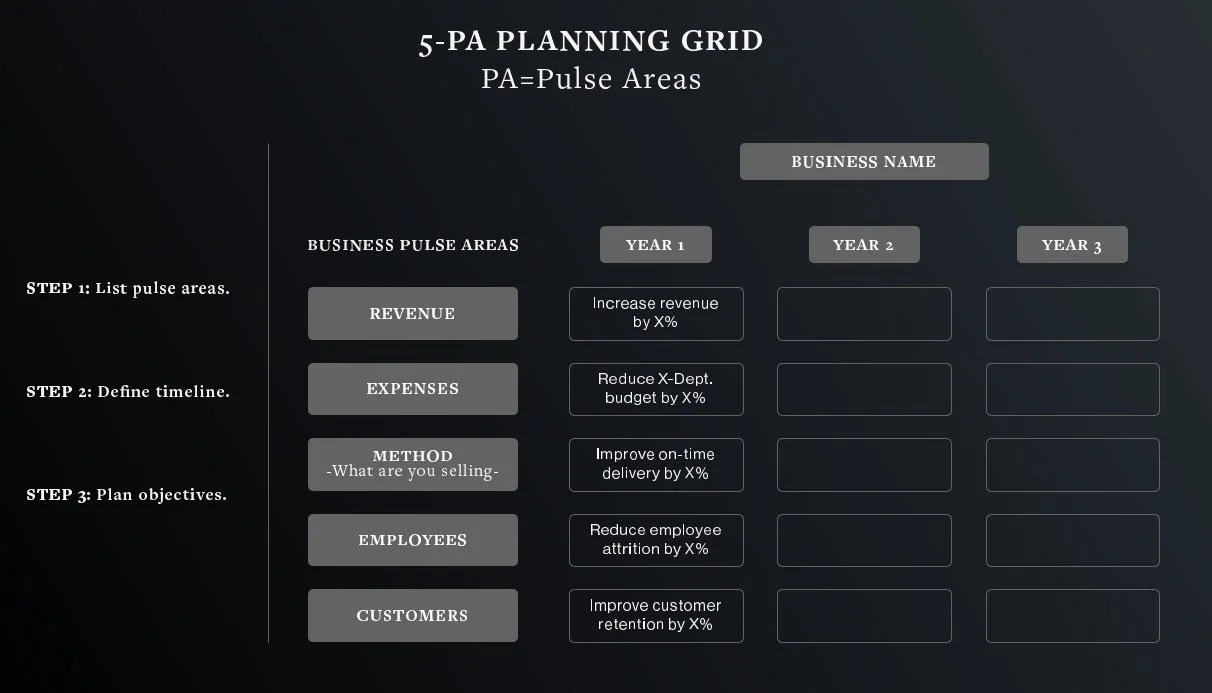
The Five Pulse Areas provide a simple, comprehensive dashboard to understand and operate your business. Most activities you engage in can be categorized into these five areas:
Revenue
This goes beyond just “top line” figures; it includes the structure of your revenue by product, customer segment, region, and channel. Are you overly reliant on one major client? Is a legacy product supporting your future, or is it hindering it? Are you too dependent on a single geography or delivery method?Expenses
The critical conversation isn’t merely about whether costs are rising or falling but about alignment with your desired business trajectory. In a fluctuating environment, treat your cost base as a dynamic portfolio that you actively manage.Method
This concerns the products and services delivered and how work is done. Including processes, systems, and delivery models. Your Method is essential for serving the market, but it often lags behind developments, which generate friction. Many organizations hide their most significant risks and untapped value within this area.Employees
Beyond headcount and engagement scores, this area assesses whether you have the right structure, skills, and leadership to succeed in the future. This involves building teams around new capabilities (like AI) without neglecting your existing workforce.Customers
This pulse evaluates who you serve, the costs associated with retaining them, and their likelihood of turning to competitors. It encourages a customer-focused perspective and is typically where you’ll first notice when your methods are losing appeal.
While individually these concepts aren’t new, collectively they provide a clear operational view of the entire organization, easily understood and acted upon by all leaders.
Plan the Expiration of Today’s Methods While You Build Tomorrow’s
If there’s one discipline that separates resilient companies from fragile ones, it’s this: they intentionally plan to retire their products, services, and technologies.
Most organizations only phase out a method once it starts to fail; often after customers have already lost interest. By then, the transition becomes more expensive and painful than necessary.
A robust operating system treats lifecycle management as a core leadership responsibility. Here’s how it works:
Recognize that every product, service, and operational method has a lifecycle with a beginning, middle, and end.
Identify where your methods fall; within Introduction, Growth, Maturity, or Decline across each of the five Pulse Areas.
Decide in advance how/if you will invest, maintain, or retire these methods.
For example, a long-standing service offering may be in the Maturity phase for revenue but in Decline operationally as it relies on manual processes that can’t be scaled. Conversely, a new AI-enabled workflow might be in the Introduction phase, promising but unproven, while your employee pulse indicates potential issues because the team has not yet been reskilled to adapt to it.
When partnering, I guide leaders in mapping these lifecycles so they can anticipate the next phase rather than react. Your role as a CEO/leader or operator is not to keep everything alive, it’s to continually decide what deserves new investment and what requires a deliberate phase-out.
Turning AI and Volatility into a Quarterly Operating Rhythm
Many companies run AI as a series of pilot projects or ignore it until a board member raises an uncomfortable question. Neither approach is effective. The solution is not “more AI projects.” Instead, establish a rhythm that integrates AI, and every other significant change, into the Pulse Areas, your operating rhythm, and value stream alignment.
Here’s how to out this into practice:
1. Start with Vision and be honest about your reality
Twice a year, gather your leadership team and ask:
What business are we trying to build over the next three years?
Given our markets, technologies, and customers, what does “winning” look like?
This is Vision in the VSA sense: a clear and concrete picture of the future business, not a slogan.
Next, confront your current state by examining key pulse areas:
Revenue: Where are we overexposed or underexposed?
Expenses: Where are we still funding outdated initiatives?
Method: Which processes are visibly struggling under current volume or complexity?
Employees: Where do we have skill and leadership gaps that hinder execution?
Customers: Where are we losing relevance or trust?
You’re not chasing perfection; you’re aiming for a shared, realistic view of where you stand.
2. Translate Vision into a small set of strategic shifts
From this reality, identify a short list of strategic shifts; critical changes you must implement now to move towards your Vision.
Examples include:
Transitioning 30% of new revenue into recurring or subscription models over the next 18–24 months.
Reducing dependence on one region by developing revenue streams in two new markets.
Replacing a labor-intensive, error-prone method with a more integrated or automated, AI-supported workflow.
Each strategic shift should be explicitly linked to at least two Pulse Areas to avoid creating “orphan strategies” that sound appealing but lack support.
3. Drive Action through a disciplined 90-day cadence
This is where many transformations falter—and where a robust operating system proves its value.
Every 90 days:
Select one to three priorities for each Pulse Area, directly connected to your strategic shifts.
Assign clear owners and establish measurable outcomes.
Commit to how the board and executive team will track progress (simple scorecards are often more effective than elaborate dashboards).
For instance, if your strategic shift involves modernizing a core method with AI:
Method Pulse: Implement the new workflow in one region or product line, with defined throughput and error-rate targets.
Employees Pulse: Train and certify a pilot group of operators on the new workflow.
Customers Pulse: Monitor cycle times and satisfaction scores before and after the change for specific customer segments.
The goal is not a perfect plan, but a consistent operating rhythm that keeps reality, strategy, and action aligned.
Leadership in an Undying Business
Tools and frameworks are only part of the equation. The rest is in how you lead.
In my experience restructuring organizations, I focus on three leadership behaviors that allow businesses to outlast their current methods.
The Courage to Retire What’s No Longer Effective
It’s much easier to invest energy into outdated offerings and structures than to acknowledge they have reached their limits. Lasting businesses are led by individuals who can confidently say, “This served us well, but it’s time to move on. Let’s sunset it properly and build what’s next.”
A Preference for Clarity Over Complexity
The Five Pulse Areas, the Business Lifecycle, and the VSA Framework are intentionally simplified. They allow leaders, managers, and teams to see a unified picture and work toward the same goals. In a volatile environment, effective leadership should be straightforward, not complex.
Consistent and Composed Communication
Your team doesn’t need you to pretend that everything is stable. They need to see that you have a way to stay stable as the world changes. When you communicate the status of each Pulse Area, outline the lifecycle stages you observe, and explain the focus for the next 90 days, you’re not just sharing information; you’re providing your organization with a sense of calm.
The Operating System is the Real Strategy
In a constantly changing business environment, having a clever strategy alone is not sufficient. The companies that withstand challenges and even become stronger are led by leaders who recognize their operating system as a crucial strategic asset. This involves five key Pulse Areas that are consistently reviewed, lifecycles that are managed deliberately, a Vision that truly guides resource allocation, and a 90-day rhythm that aligns all activities with action.
Everything else is just noise.
If you’re a CEO, leader, or an operator feeling the pressure of change from multiple directions, don’t launch yet another initiative. Instead, focus on your operating system. Map your pulses, define your lifecycles, and streamline your rhythm. Be the steady voice in your organization that reminds everyone:
We can’t control the turbulence, but we can control how we navigate through it.
That’s the essence of a resilient business.